Course 1 · For traders, analysts and portfolio managers
Expert Oil Trader, Hormuz Edition
Analyse the oil market the way it traded in 2026. Follow the Strait of Hormuz crisis from the closure to the reopening, and learn the methods that separated good calls from bad ones.
- Modules
- 15, about an hour each
- Level
- Professional. Finance background helps; oil experience is not needed
- Format
- Narrated video with subtitles
- Schedule
- Self-paced
- Certificate
- Certificate and CPD log
- Price
- USD 999 per learner
What you'll learn
- Build and defend an oil balance for a major supply shock
- Read the physical evidence: tankers, storage and what the data misses
- Score geopolitical events with odds and defined tails
- Explain why price and balance diverged, and what closed the gap
- Turn a view into a trade in futures, spreads and cracks, with its risk set
- Critique a real 2026 trade sequence, step by step
Skills you'll gain
- Supply and demand balances
- Inventory analysis
- Physical oil flows
- Refining and crack spreads
- Price formation
- Geopolitical risk
- Trade construction
- Risk management
There are 15 modules in this course
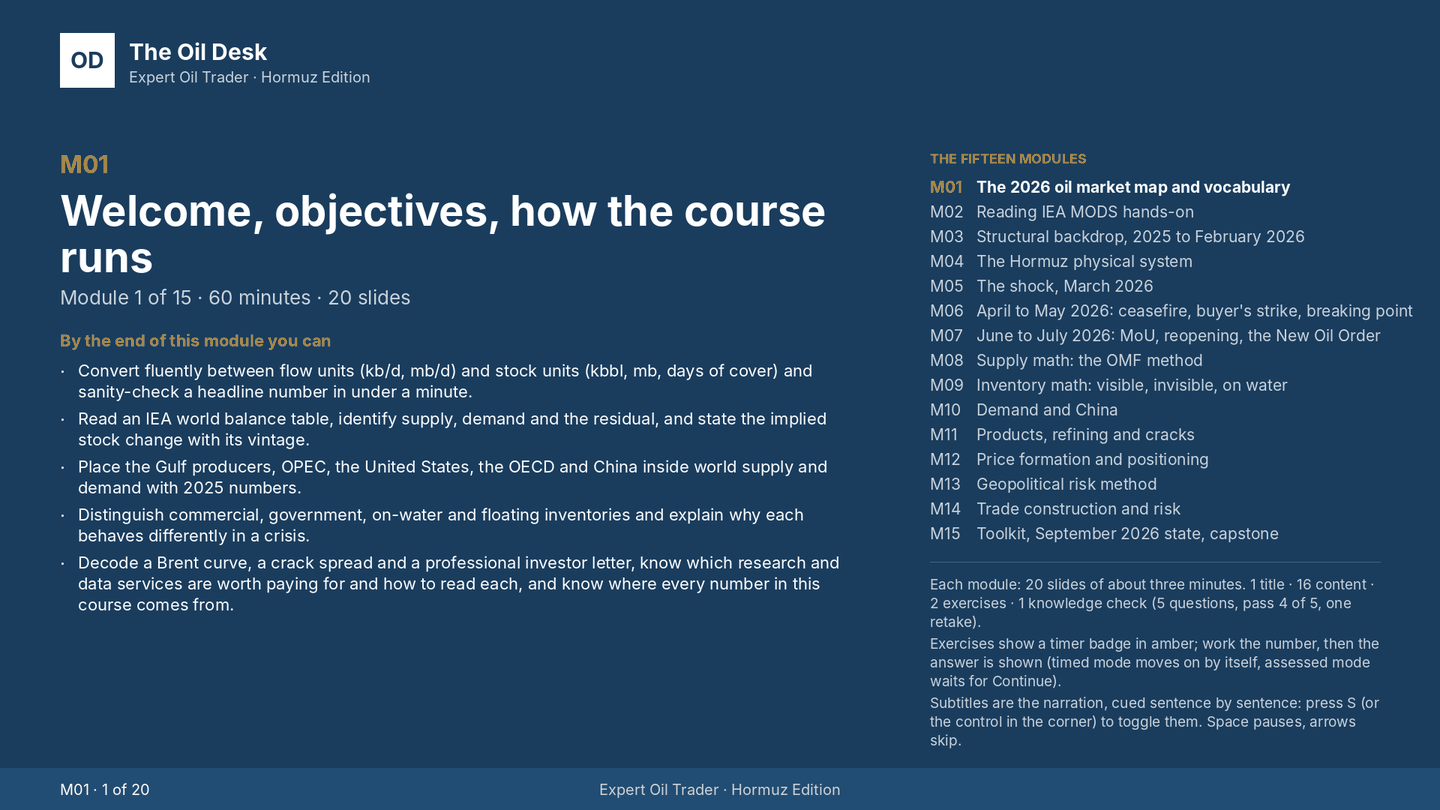
Each module has 20 slides: an overview, 16 lessons, 2 timed exercises and a 5-question check. The order runs from the market map, through the crisis month by month, to the methods and the trade.
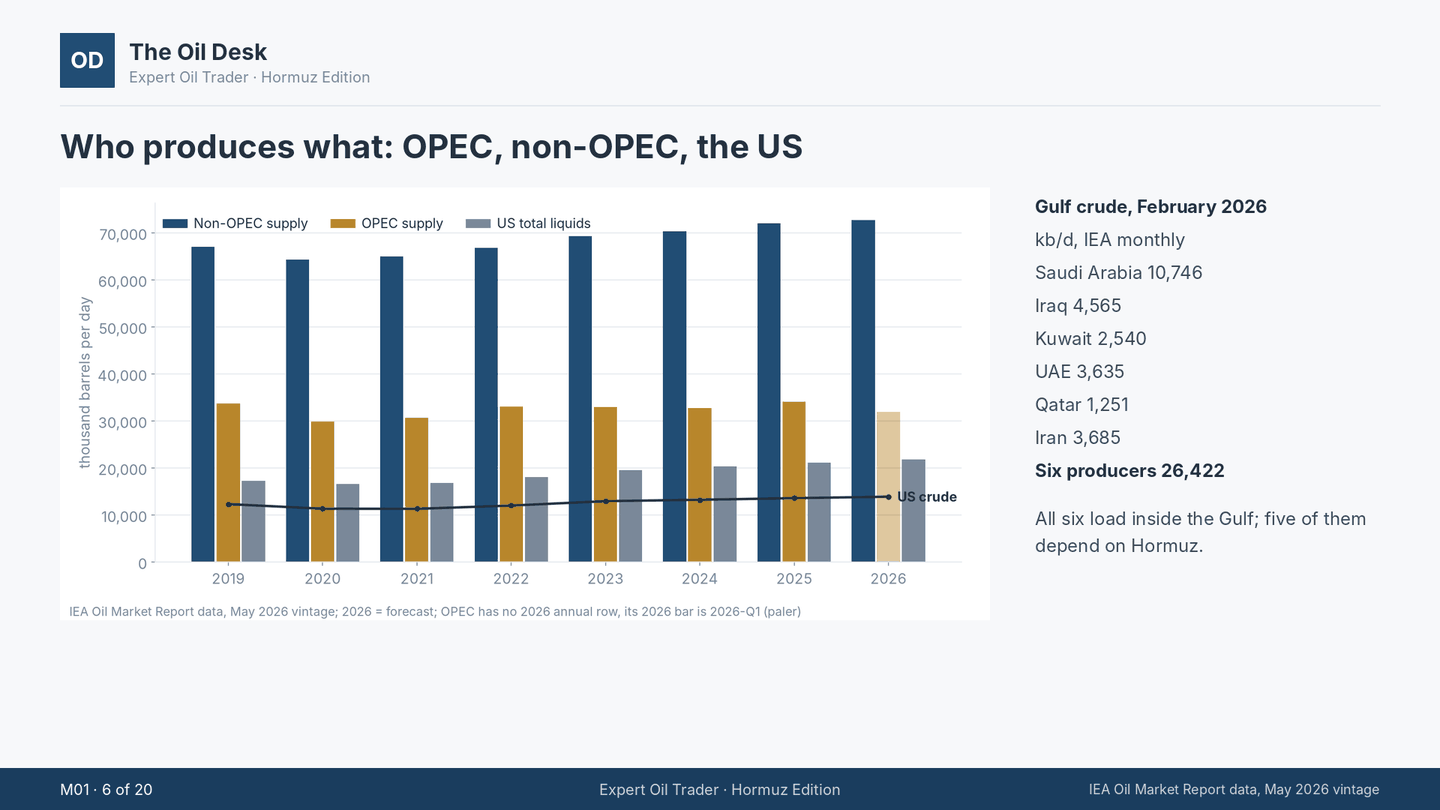
Module 1 The 2026 oil market map and vocabulary 48 min
You'll be able to: Read a global balance and speak the units.
Why it matters: Baseline product knowledge for anyone analysing, trading or supervising oil exposure.
Module 2 Reading IEA MODS hands-on 64 min
You'll be able to: Pull, chart and critique IEA series.
Why it matters: Data literacy and the ability to challenge a number.
Module 3 Structural backdrop, 2025 to February 2026 62 min
You'll be able to: State the pre-crisis consensus and the contrarian case.
Why it matters: Context for judging whether a shock hits a tight or a loose market.
Module 4 The Hormuz physical system 69 min
You'll be able to: Draw the system from wellhead to Gulf of Oman with the numbers.
Why it matters: Product and infrastructure knowledge for risk judgement.
Module 5 The shock, March 2026 60 min
You'll be able to: Narrate March day by day with price and evidence.
Why it matters: Case knowledge of the defining event of the year.
Module 6 April to May 2026: ceasefire, buyer's strike, breaking point 59 min
You'll be able to: Explain invisible draws and the price plateau.
Why it matters: Judging a market that refuses to behave.
Module 7 June to July 2026: MoU, reopening, the New Oil Order 63 min
You'll be able to: Explain the June crash and the July re-tightening.
Why it matters: Judging a regime change and two houses disagreeing.
Module 8 Supply math: the OMF method 60 min
You'll be able to: Build a shut-in and offset model and defend it.
Why it matters: Core analytical competence.
Module 9 Inventory math: visible, invisible, on water 61 min
You'll be able to: Track inventories across four layers and predict when draws become visible.
Why it matters: The discipline that separated good calls from bad in 2026.
Module 10 Demand and China 60 min
You'll be able to: Separate demand loss, run cuts and stock behaviour.
Why it matters: The demand judgement most people got wrong.
Module 11 Products, refining and cracks 62 min
You'll be able to: Read and trade the product complex.
Why it matters: Where the P&L actually moved in 2026.
Module 12 Price formation and positioning 61 min
You'll be able to: Explain why price and balance diverged and what closed the gap.
Why it matters: Reconciling balances with prices, the trader's core skill.
Module 13 Geopolitical risk method 58 min
You'll be able to: Score events, assign odds, define tails.
Why it matters: Structured judgement of political events, the skill the year rewarded.
Module 14 Trade construction and risk 65 min
You'll be able to: Reconstruct and critique a real 2026 trade sequence.
Why it matters: Converting a view into a position with controlled risk.
Module 15 Toolkit, September 2026 state, capstone 77 min
You'll be able to: Run the analysis on the current market and work the capstone case.
Why it matters: Bringing the method live and evidencing competence.
See inside
Earn a certificate
Finish all 15 modules to receive a certificate and a CPD log. The log shows the date, time spent, mode and result for each module, ready for your firm's training file.
How you're assessed
Each module ends with a five-question check. Pass with four of five; you get one retake.
An optional final assessment of 20 questions adds "assessed" to your certificate. Pass with 14 of 20.
Start learning today
USD 999 per learner. Pay by card or invoice. Education, not investment advice.